The Cure for Boredom is Curiosity: Why This Mindset Powers Learning, Design, and Everyday Innovation
Curiosity isn’t just a childhood trait—it’s a renewable cognitive resource that sharpens attention, deepens understanding, and transforms routine into revelation. When we say The Cure for Boredom is Curiosity, we’re naming something fundamental: boredom often signals not emptiness, but untapped potential—information waiting to be connected, patterns begging to be noticed, questions unasked. That principle doesn’t fade with age; it simply changes form. In classrooms, studios, home offices, and workshops, curiosity becomes the quiet engine behind meaningful engagement—and nowhere is that more visible than in how people choose to express ideas visually, especially through intentional, idea-driven apparel like back-to-school T-shirt designs.
How Curiosity Shapes Meaningful Visual Communication
Consider the phrase “back to school.” For many, it evokes logistics—supplies, schedules, transitions. But when filtered through curiosity, it becomes an invitation: What new perspectives might students bring this year? What assumptions can educators re-examine? How might a simple T-shirt design serve as both identity marker and intellectual catalyst?
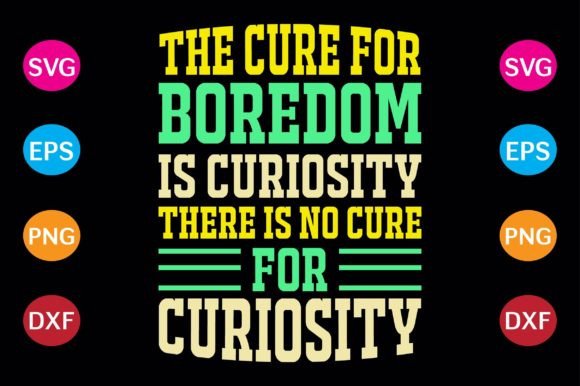
A design titled The Cure for Boredom is Curiosity does more than decorate fabric. It operates on three levels simultaneously:
- Cognitive cue: It reminds the wearer—and those who see it—that disengagement is rarely permanent; it’s often a pause before inquiry.
- Social signal: It quietly identifies shared values—lifelong learning, open-mindedness, intellectual humility—without jargon or dogma.
- Design anchor: Its phrasing invites visual interpretation—not just typography, but symbolism (magnifying glasses, winding paths, lightbulbs dissolving into constellations), spacing, contrast, and hierarchy.
This is why such a phrase resonates across audiences: a researcher selecting conference apparel, a teacher designing classroom culture, a parent supporting a child’s emerging interests, or a small-business owner branding educational merchandise. The strength lies not in novelty, but in fidelity to a timeless human dynamic—the link between attention and wonder.
Why Digital Download Files Matter for Real-World Use
The practical value of a design like The Cure for Boredom is Curiosity multiplies when delivered as a versatile digital download. Unlike static images or single-format files, this offering includes a ZIP archive containing SVG, DXF, EPS, and high-resolution PNG files—each serving distinct production needs.
SVG (Scalable Vector Graphics) preserves crisp edges at any size, making it ideal for web use, Cricut or Silhouette cutting machines, and responsive design systems. DXF (Drawing Exchange Format) bridges compatibility with industrial CNC tools and laser cutters—valuable for educators running makerspaces or small shops producing embroidered patches. EPS (Encapsulated PostScript) remains a print-industry standard for professional screen printing and vector-based layout software like Adobe Illustrator. And the high-resolution PNG ensures pixel-perfect rendering for mockups, social media previews, or direct-to-garment (DTG) printing where raster clarity matters.
That breadth isn’t convenience—it’s empowerment. A homeschooling parent can resize the SVG for a laminated classroom poster. A university student group can import the DXF into Glowforge software to etch the phrase onto wooden bookmarks. An art teacher can layer the EPS elements in a lesson on typography hierarchy. A nonprofit launching a STEM outreach campaign can drop the PNG into a Canva presentation without quality loss. The file set reflects an understanding that curiosity manifests differently across tools, constraints, and contexts.
Applications Beyond Apparel: From Classrooms to Community Projects
While “back to school” anchors the seasonal relevance, the utility of this design extends far beyond August. Its adaptability reveals how curiosity-driven content supports diverse workflows:
- Educators embed it in syllabi, slide decks, or welcome packets—not as decoration, but as a stated norm. One middle-school science teacher prints it on tent cards for lab tables, sparking discussion about how questions drive experimentation (“What would happen if we changed *this* variable?”).
- Librarians and museum educators use the SVG to create interactive floor decals in children’s sections, pairing the phrase with QR codes linking to local discovery trails or citizen-science projects.
- Professional development facilitators integrate the design into workshop handouts on fostering psychological safety—framing curiosity as the antidote to defensiveness during feedback cycles.
- Hobbyists and makers remix the EPS layers to combine with botanical illustrations or circuit diagrams, turning a T-shirt into a conversation starter about interdisciplinary thinking.
Crucially, none of these uses require licensing negotiations or attribution hurdles—because the digital download grants immediate, royalty-free usage rights for personal and commercial purposes (with standard exclusions for resale of the raw digital files themselves). That freedom lowers barriers to implementation, aligning with the very ethos the phrase embodies: removing friction so curiosity can flow.
Design Integrity Meets Functional Clarity
Effective curiosity-driven design avoids cliché. It resists overused tropes—exclamation points, cartoon brains, or forced puns—opting instead for compositional choices that invite closer looking. For instance, the kerning (letter spacing) in The Cure for Boredom is Curiosity might subtly tighten around “is,” visually underscoring the active, relational nature of the statement. Or the word “Curiosity” could appear in a slightly warmer hue than “Boredom,” suggesting temperature as metaphor—stagnation versus kinetic energy.
Such details matter because they mirror how curiosity operates: not as a loud declaration, but as a quiet shift in focus. A well-executed design doesn’t shout “be curious!”—it creates conditions where noticing becomes natural. That’s why the included file formats prioritize editability: users can adjust color palettes to match school branding, isolate “Curiosity” for a badge icon, or convert text to outlines while preserving vector integrity for embroidery digitizing.
Who Benefits—and How They Use It Differently
The reach of this concept spans sectors precisely because its core mechanism—replacing passive consumption with active questioning—is universally applicable:
- Students (K–12 and higher education) wear it as both affirmation and aspiration—especially during transition periods like freshman orientation or returning after remote learning gaps. It signals belonging to a community that values inquiry over rote performance.
- Educators and administrators adopt it for faculty retreats or staff appreciation events, reinforcing that professional growth stems from asking “What if we tried…?” rather than defaulting to inherited practices.
- Researchers and academic communicators feature it in conference swag or lab signage, gently challenging disciplinary silos by implying that curiosity transcends methodology.
- Small business owners in education-adjacent spaces—like tutoring centers, coding camps, or art supply stores—use the files to create cohesive, values-aligned merch that differentiates them from generic vendors.
- Parents and caregivers select it not just for kids, but for themselves—modeling that learning doesn’t stop at graduation, and that curiosity is a practice, not a trait.
Each group engages the same phrase, yet interprets its weight differently. That flexibility isn’t accidental—it emerges from grounding the message in observable human behavior rather than abstract ideals. Boredom is measurable (attention drift, task abandonment); curiosity is observable (question frequency, exploration duration, hypothesis generation). Linking them operationally makes the phrase useful, not merely inspirational.
Long-Term Value: Beyond the Back-to-School Season
Unlike trend-dependent designs that feel dated by October, The Cure for Boredom is Curiosity gains resonance over time. As learners advance, the phrase evolves with them: for a fifth grader, it might spark interest in backyard entomology; for a graduate student, it might underpin thesis research questioning dominant paradigms in their field. Its durability lies in its refusal to prescribe answers—only to affirm the legitimacy of the question itself.
That makes the digital download more than a seasonal purchase. It’s infrastructure. Educators build curricula around it. Designers use its typographic rhythm as a study in readability. Parents keep the files archived for future years’ projects. And creators remix it—not as derivative work, but as iterative thinking: adding localized translations, translating it into tactile braille overlays for inclusive classrooms, or animating the SVG for digital learning platforms.
In essence, the ZIP file delivers not just graphics, but permission—to adapt, to apply, to reinterpret. And that permission mirrors the central promise of the phrase: that curiosity isn’t a fixed state to achieve, but a stance to return to, again and again, whenever attention falters or meaning feels thin. Whether printed on cotton, etched into metal, or projected onto a lecture hall wall, The Cure for Boredom is Curiosity endures because it names a truth we all recognize—and offers no shortcut, only the next thoughtful question.