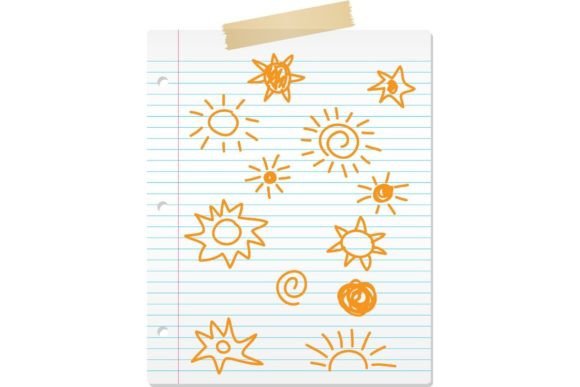
Hand Drawn Sun Doodles: A Versatile, Authentic Design Resource for Creative Professionals and Educators
Hand Drawn Sun Doodles is more than a decorative asset—it’s a thoughtfully crafted design element rooted in tactile authenticity. Unlike algorithmically generated icons or overly polished vector sets, this collection features sun illustrations drawn by hand on lined paper, preserving the subtle irregularities of human gesture: slight wobbles in rays, gentle variations in line weight, and the soft texture of pencil on ruled lines. These aren’t just clipart; they’re expressive, warm, and intentionally imperfect—qualities that resonate deeply in today’s design landscape, where audiences increasingly favor sincerity over sterility.
Why Imperfection Adds Value in Digital Design
In an era saturated with AI-generated visuals and hyper-symmetrical graphics, Hand Drawn Sun Doodles stands out precisely because it embraces organic imperfection. The slight tilt of a sun’s center, the uneven spacing between rays, or the faint ghosting of a pencil stroke—all these details communicate humanity. For educators crafting classroom materials, that warmth builds approachability. For small businesses designing social media banners, it signals authenticity over corporate gloss. And for web designers integrating elements into landing pages, it introduces visual contrast that guides attention without shouting.
This isn’t nostalgia for its own sake. Research in visual cognition shows that moderately irregular shapes are processed more slowly—and therefore more memorably—than perfectly geometric ones. When a student sees a Hand Drawn Sun Doodle on a back-to-school flyer, the brain lingers just a fraction longer, increasing retention. When a nonprofit uses the same doodle in an Instagram story about summer learning programs, the hand-drawn quality subtly reinforces values like care, accessibility, and community effort.
Practical Applications Across Real-World Contexts
The utility of Hand Drawn Sun Doodles extends far beyond aesthetic decoration. Its dual-format delivery—vector EPS and high-resolution JPG (300 dpi)—enables seamless adaptation across both scalable digital interfaces and print-ready assets. Below are concrete use cases, grounded in actual workflows:
- Educators and Curriculum Designers: Integrate the sun doodle into editable Google Slides templates for seasonal science units (e.g., solar system lessons or photosynthesis diagrams). The lined-paper background provides instant visual context—no need to layer additional textures. Teachers report that students respond more enthusiastically to lesson materials featuring hand-drawn elements, citing increased engagement during independent worksheet time.
- Small Business Owners: Use the EPS file to scale the doodle for vinyl decals on café windows promoting “Summer Specials,” then repurpose the same asset as a watermark on email newsletters. Because the vector retains crispness at any size, there’s no need to juggle multiple file versions—a critical efficiency for solopreneurs managing their own branding.
- Web Designers & UX Practitioners: Apply the sun as a subtle hover state icon for “brighten theme” toggle buttons, or embed it as an SVG inline to ensure fast loading and responsive behavior. Its simplicity avoids visual clutter while reinforcing positive emotional associations—light, energy, optimism—without relying on color psychology alone.
- Nonprofit Communications Teams: Layer the JPG version over photography in annual reports to highlight summer outreach initiatives (e.g., sun doodles floating beside images of youth camps or community gardens). At 300 dpi, it prints cleanly alongside high-res photos, maintaining professional polish even in full-color brochures.
- Hobbyists and DIY Creators: Print the JPG on sticker paper to create custom labels for homemade preserves, or trace the EPS outline onto wood for laser-cut wall art. Its clean silhouette and open negative space make it unusually adaptable for physical fabrication methods.
Technical Flexibility Meets Creative Intuition
What makes Hand Drawn Sun Doodles especially valuable is how its technical specifications align with real-world production constraints. The included EPS file is compatible with Adobe Illustrator, CorelDRAW, Affinity Designer, and most vector editing tools—not just as a static image, but as a fully editable path. Designers can adjust individual rays, recolor strokes non-destructively, or combine the sun with other hand-drawn assets to build cohesive illustration systems.
Meanwhile, the 300 dpi JPG serves a distinct purpose: immediate usability. No software required—just drag, drop, and place. This matters for users who don’t identify as “designers”: school administrators updating PTA flyers in Canva, researchers adding visual anchors to conference presentation decks, or local librarians designing summer reading program posters in Microsoft PowerPoint. The high resolution ensures clarity whether displayed on a retina-screen laptop or printed on newsprint for neighborhood bulletin boards.
Importantly, neither file includes embedded fonts, transparency limitations, or proprietary layers—barriers that often derail last-minute edits. That intentional simplicity reflects deep understanding of cross-role collaboration: when a graphic designer hands off assets to a marketing coordinator or volunteer team, friction drops significantly.
User-Centered Considerations for Ethical Implementation
While Hand Drawn Sun Doodles offers broad utility, thoughtful implementation requires attention to context and audience. For example:
- Accessibility: When used as a standalone icon (e.g., in a weather app), ensure sufficient contrast against backgrounds and pair it with descriptive alt text (“hand-drawn sun symbolizing clear skies”). Its informal style shouldn’t compromise WCAG 2.1 AA compliance.
- Cultural Resonance: In global educational materials, consider how sun motifs function symbolically across regions. While universally associated with light and life, specific interpretations—such as solar deities or agricultural cycles—may warrant contextual annotation or complementary imagery.
- Scale Sensitivity: The charm of hand-drawn texture diminishes if scaled too small (below 24px height) or stretched disproportionately. Always test visibility on mobile previews and printed proofs before finalizing layouts.
- Licensing Clarity: Though not covered in the asset description, users should verify usage rights for commercial redistribution—especially if incorporating the doodle into templates sold on marketplaces like Creative Market or Etsy. Most standard licenses permit derivative works but restrict resale of the raw file itself.
How It Fits Within Evolving Design Trends
Hand Drawn Sun Doodles arrives at a meaningful inflection point in visual communication. We’re moving past the “flat design” minimalism of the early 2010s and the “glass morphism” experimentation of the mid-2020s toward what design strategist Ellen Lupton terms “tactile realism”—a return to material honesty in digital spaces. This trend values visible process: grain, pressure variation, paper fiber, margin notes. It’s why sketch-style UI kits, scanned watercolor brushes, and analog-inspired typography are gaining traction among forward-thinking studios.
Yet Hand Drawn Sun Doodles avoids trend fatigue by being fundamentally functional—not merely stylistic. Its lined-paper base isn’t a gimmick; it’s a compositional anchor. Those horizontal rules provide implicit alignment cues for text blocks, making it easier to integrate into educational handouts or bilingual flyers where consistent baseline spacing improves readability. That dual role—as both motif and structural guide—is rare among single-element assets.
Real-World Observations from Early Adopters
Feedback from diverse users reveals unexpected strengths. A university writing center reported that tutors began using printed Hand Drawn Sun Doodles as “positive reinforcement stamps” on student drafts—replacing generic gold stars with something more distinctive and conversation-starting (“Why did you choose the sun?” led to discussions about metaphor and tone). A pediatric clinic incorporated the doodle into intake forms for seasonal wellness checks, noting that children aged 4–8 were more willing to complete paperwork when familiar, friendly symbols were present.
Even in data visualization, the sun has proven unexpectedly useful: one public health researcher used the vector outline as a custom marker in a GIS map tracking summer vaccination rates, finding that its recognizability improved stakeholder comprehension compared to standard circle markers.
Getting Started Without Overcomplicating
For those new to incorporating hand-drawn elements, begin small. Try replacing a default bullet point with a tiny sun doodle in a project brief. Insert the JPG into a slide footer as a quiet brand signature. Or use the EPS to trace over a photo background, creating a cutout effect for social media announcements.
Avoid overloading layouts—this asset earns impact through restraint. One sun doodle, well-placed, communicates more than five competing illustrations. Its strength lies not in multiplicity, but in resonance: a quiet, confident reminder that clarity, warmth, and human touch remain indispensable—even in highly technical, fast-moving creative workflows.