5 Autumn Short Stories for Kids
Imagine a resource that does more than entertain—it sparks storytelling, builds seasonal literacy, and invites hands-on creativity across classrooms, homes, and small creative businesses. 5 Autumn Short Stories for Kids is exactly that: a compact, 30-page digital book designed not just for reading, but for adapting, extending, and reimagining.
Each of the five stories—The Magical Leaf, Pumpkin Patch Mystery, The Brave Little Squirrel, The Enchanted Forest, and The Enchanted Leaf: Autumn Adventures Begin—blends gentle narrative with strong visual hooks. They’re written with rhythmic language and clear emotional arcs, making them ideal for early readers, shared storytime, or as springboards for cross-curricular learning. But their real value lies in how easily they can be repurposed—not as static content, but as flexible creative assets.
Creative Possibilities Beyond the Page
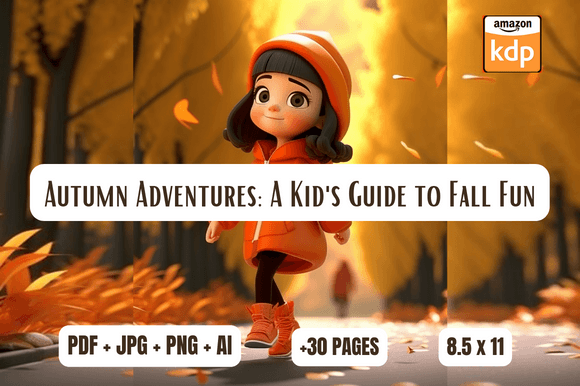
This isn’t a “print-and-go” coloring book in the traditional sense. It’s a toolkit. The included illustrative pictures—clean-lined, expressive, and sized for 8.5 x 11” use—are optimized for both digital and physical output. That means educators can pull individual scenes to build interactive slide decks; indie designers can isolate motifs (acorns, foxes, maple leaves) for pattern libraries; and small publishers can adapt layouts for Amazon KDP without redesigning from scratch.
For example, The Pumpkin Patch Mystery includes a sequence of three illustrated clues—a crooked scarecrow, a half-buried lantern, and a trail of tiny paw prints. These aren’t just decorative. They’re ready-made visual prompts for sequencing activities, inference exercises, or even stop-motion animation storyboards. A homeschool parent might print just those three images, laminate them, and turn them into a tactile prediction game. A children’s app developer could animate them with simple sound cues and voiceover narration—using the existing text as script foundation.
Real-World Applications by Audience
Educators & Curriculum Designers: Use the stories as anchor texts for seasonal units. Pair The Brave Little Squirrel with science lessons on animal behavior and food storage—or with SEL work on empathy and cooperation. The consistent character-driven structure supports comprehension strategy instruction: identifying problem/solution, tracking character growth, or comparing settings across stories.
Content Creators & Bloggers: Repurpose each story into themed blog posts or social carousels. Turn The Enchanted Forest into a “Fall Color Science” post: explain why leaves change color (chlorophyll breakdown, anthocyanins), then link to printable leaf-matching pages using the book’s illustrations. Embed a free sample page (with attribution) to drive traffic—and offer the full PDF as a lead magnet.
Small Publishers & Indie Authors: This book was built for scalability. Its AI, JPG, and PNG file formats let you tweak colors for different editions—warm tones for a “cozy fall” version, high-contrast black-and-white for accessibility-focused releases, or pastel overlays for a “gentle autumn” variant. The included cover (free, all rights reserved © 2023) is professionally formatted for Kindle Direct Publishing and Print-on-Demand services—no extra design fees.
Art Teachers & After-School Program Leads: The line art is intentionally bold and uncluttered—not overly detailed, but rich in shape and gesture. That makes it perfect for mixed-media extension: students can collage over printed pages with tissue paper, add texture with crayon resist, or translate scenes into clay sculptures. One teacher we spoke with used The Magical Leaf as the basis for a collaborative mural—each child illustrated one line of the story on a 12”x12” tile, then assembled them into a vertical “story tree.”
Staying Organized, Consistent, and Audience-Focused
When adapting 5 Autumn Short Stories for Kids, consistency starts with intention. Ask: *Who is this for? What action do I want them to take?* A kindergarten teacher needs clear, low-prep extensions. A freelance illustrator wants editable vector layers (hence the AI format). A mom running a local craft fair wants printable activity cards that fit neatly into a $5 “Fall Fun Kit.”
To keep adaptations effective: maintain the original tone—gentle, warm, quietly wondrous—and avoid overcomplicating language or visuals. If adding educational notes, place them separately (e.g., a teacher guide PDF), not layered onto story pages. If converting to audio, record at a measured pace (110–120 wpm) and pause after key lines to allow for reflection or repetition.
Originality comes not from rewriting the stories, but from how you frame them. Instead of “coloring pages,” position them as “story starters.” Instead of “fall activities,” call them “seasonal thinking tools.” That subtle shift aligns with how modern parents and educators evaluate resources: not just *what* it is, but *how it grows with the child*.
Why This Format Works Right Now
Digital-first, print-ready resources are in demand—not because people prefer screens over paper, but because flexibility matters. A school district may license the PDF for classroom use, while a grandparent buys the printed version at a local bookstore. A blogger embeds a single JPG in a roundup post; an Etsy seller bundles the PNGs into a “Fall Classroom Decor Kit.”
The 8.5 x 11” dimension ensures compatibility across standard printers, cutting machines, and presentation software. And because it’s delivered as multiple file types—not just one locked format—you’re never stuck. Need transparency for layering in Canva? Use the PNG. Want to edit text or resize elements? Open the AI file in Illustrator. Prepping for a quick social post? Grab the JPG.
Most importantly, 5 Autumn Short Stories for Kids avoids trend-chasing. It doesn’t rely on viral characters or forced humor. It leans into quiet authenticity—the rustle of dry leaves, the weight of a just-picked pumpkin, the quiet courage of a small creature preparing for change. That groundedness makes it durable across seasons, platforms, and teaching philosophies.
If you’re looking for autumn-themed material that supports real engagement—not just decoration—this is a starting point with room to grow. Not as a finished product, but as raw creative material: respectful of children’s attention, practical for adult execution, and open-ended enough to meet your goals without demanding you fit into someone else’s mold.