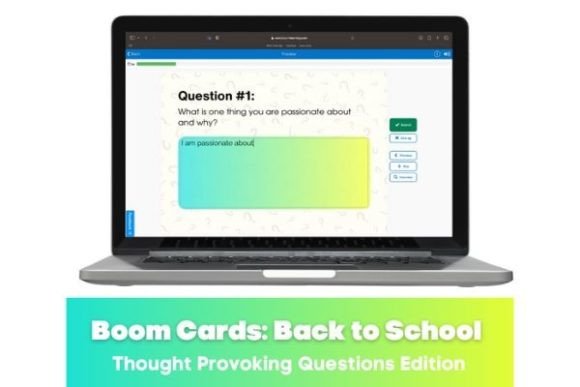
Boom Card Thought Provoking Task Cards
Back-to-school season isn’t just about syllabi and supply lists anymore—it’s about intentionality. In classrooms where students arrive with layered experiences, digital fluency, and heightened awareness of identity and belonging, educators are rethinking how connection begins. That’s where Boom Card Thought Provoking Task Cards step in—not as another checklist item, but as a deliberate, human-centered tool for launching the year with depth, dignity, and authenticity.
Why “Getting to Know You” Just Got More Nuanced
Traditional icebreakers—two truths and a lie, favorite color, dream vacation—still have value. But for upper middle and high school learners (grades 8–12), surface-level prompts often miss the mark. Today’s students navigate complex social ecosystems, evolving self-concepts, and real-world concerns—from climate anxiety to digital citizenship. They respond not to performative engagement, but to questions that signal: Your perspective matters. Your voice is invited—not just heard, but held.
That’s the design principle behind the Connections Unlocked Engaging Digital Task Cards. These aren’t fill-in-the-blank worksheets disguised as conversation starters. They’re 20 open-ended, teacher-crafted prompts built on developmental research and classroom experience—questions like “What’s something you’ve changed your mind about—and what helped you see it differently?” or “When have you felt most like ‘yourself’ in a group setting? What made that possible?” Each one invites reflection, narrative, and nuance—without demanding vulnerability on command.
Digital by Design—Not Just Because It’s Convenient
The shift to digital task cards isn’t about chasing tech for its own sake. It’s about aligning format with function. When students respond directly on screen—using text boxes, audio notes (where enabled), or even embedded sketch tools—they engage more deliberately than when rushing through paper handouts. There’s no lost worksheet, no illegible handwriting, no lag between prompt and response. Teachers gain immediate, organized insight—not just who likes pizza, but how students frame resilience, define fairness, or describe moments of quiet confidence.
And because Boom Learning’s platform is accessible across devices and integrates with most LMS systems (Google Classroom, Canvas, Schoology), setup takes minutes—not hours. No printing. No cutting. No laminating. Just click, assign, and begin observing patterns: which students lean into philosophical questions, who uses metaphor to express emotion, whose answers reveal untapped leadership or empathy. That kind of observational data informs differentiation far more meaningfully than any pre-assessment quiz.
How This Fits Into Broader Shifts in Education and Work
This resource reflects larger, well-documented shifts—not just in pedagogy, but in how people learn, collaborate, and build trust. Remote and hybrid learning accelerated demand for asynchronous yet relational tools. Meanwhile, employers across industries now prioritize emotional intelligence, active listening, and cross-cultural communication—skills best cultivated through sustained, reflective dialogue, not one-off activities.
Teachers using these Boom Card Thought Provoking Task Cards aren’t just “doing an icebreaker.” They’re modeling how to ask better questions—how to listen before solving, how to hold space without fixing. That mindset transfers beyond the classroom: freelance designers use similar frameworks to uncover client values before sketching a logo; nonprofit teams apply parallel prompts during onboarding to align around shared purpose; even small business owners adapt them in team retrospectives to surface unspoken friction or alignment.
Realistic Use Cases—Beyond Day One
While ideal as a first-week anchor, the versatility of these digital task cards reveals itself over time:
- Advisory or homeroom reflection: Rotate one prompt weekly—pair responses with short peer feedback (“What resonated? What surprised you?”) to deepen listening habits.
- Cross-curricular extension: In English, connect a question about “a time you advocated for someone else” to persuasive writing units. In science, link “a moment you changed your thinking after new evidence” to the nature of scientific inquiry.
- Re-entry support: After breaks or transitions (e.g., returning from remote learning), revisit earlier responses alongside new ones—helping students notice growth in their own reasoning or self-awareness.
- Family engagement: Share anonymized, aggregated themes (e.g., “Many of you named curiosity as your strongest learning tool this year”) in newsletters—building transparency and shared language between home and school.
What Teachers Actually Say Works—And What Doesn’t
Educators consistently highlight two practical wins: time saved and insight gained. One 9th-grade history teacher reported cutting her “getting to know you” prep from 90 minutes to 12—while gaining richer baseline data on student values than she’d collected in five years of paper journals. Another noted how quiet students, who rarely raise hands, wrote nuanced, thoughtful responses—revealing strengths she hadn’t yet seen in whole-group discussion.
But success hinges on implementation, not just access. Teachers who pair the Boom Card Thought Provoking Task Cards with clear norms—e.g., “Responses don’t need to be shared aloud unless you choose,” “It’s okay to pass on a question and try another”—see deeper participation. Those who follow up with brief, low-stakes conversations (“I read your answer about creative risk-taking—can you tell me more about that project?”) reinforce safety and continuity.
Not a Replacement—But a Reliable Catalyst
No digital tool replaces the irreplaceable: eye contact, tone of voice, the pause before a student chooses their words. What Boom Card Thought Provoking Task Cards do exceptionally well is lower the barrier to entry—making reflection and sharing feel less like performance and more like practice. They offer structure without rigidity, choice without chaos, and digital convenience without sacrificing humanity.
For educators balancing curriculum demands, relationship-building, and their own capacity, that balance matters. For students navigating adolescence in a world of constant input and fragmented attention, being asked a question that assumes they have something meaningful to say—and then having space to say it thoughtfully—is quietly revolutionary.
Where to Start—Without Overcomplicating It
You don’t need to overhaul your entire first week. Try this:
- Assign just three cards on Day One—not all 20. Let students choose which ones resonate.
- After submissions, scan responses for recurring themes (e.g., several mention music as emotional grounding) and name them in class: “I noticed many of you described music as a source of calm—that tells me rhythm and sound might be useful anchors in our discussions.”
- Save the remaining cards for intentional moments later—before group projects, after a challenging text, or mid-semester when energy dips.
That’s the quiet power of well-designed digital task cards: they meet modern workflows without sacrificing depth, honor student agency while scaffolding reflection, and turn “getting to know you” from a ritual into a relational foundation—one thoughtful question at a time.